
Aid Ally
Crisis Tech · AR · Humanitarian Design · Harvard · 2024
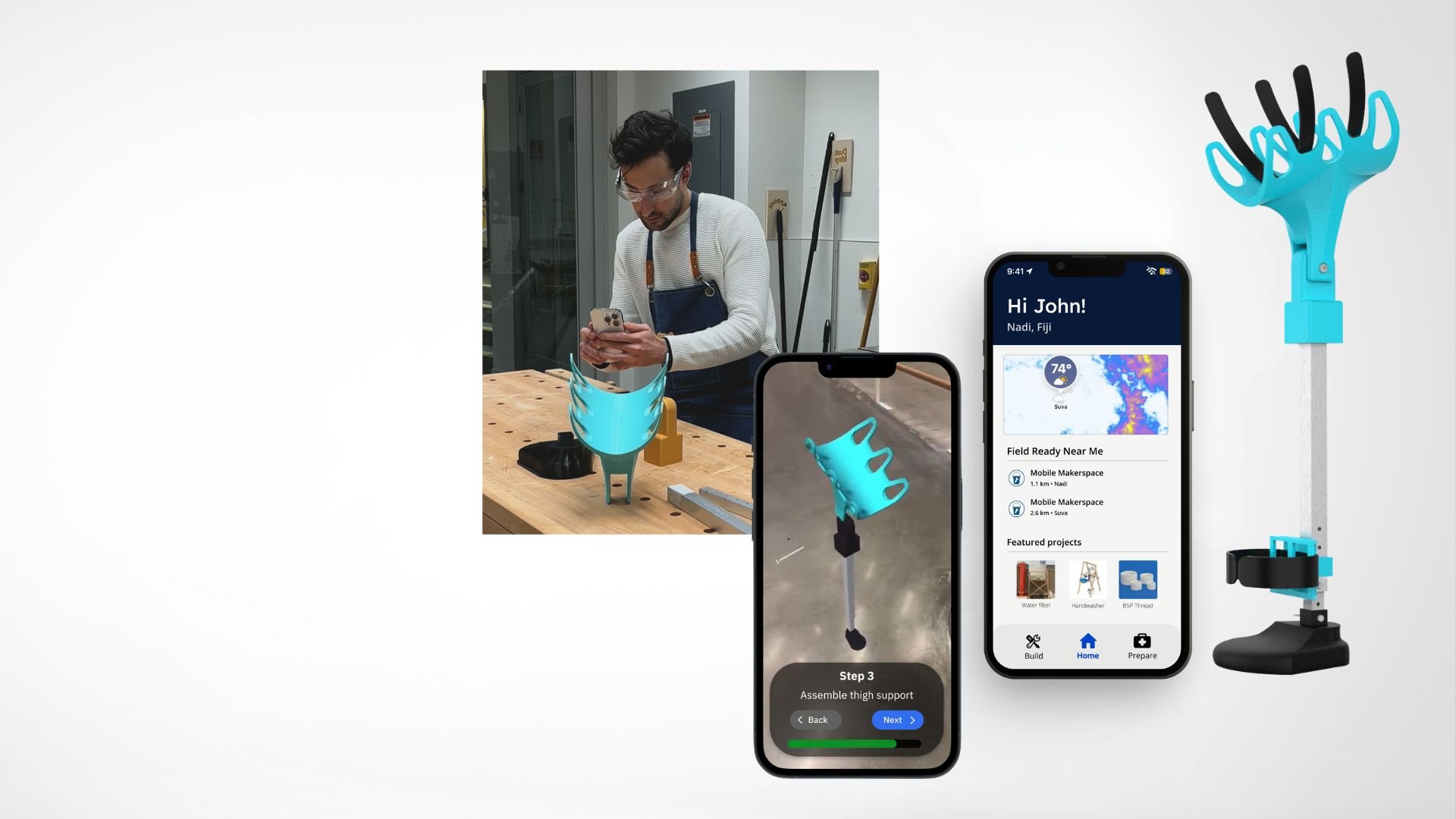
After a disaster, medical supply chains collapse within hours. Orthopaedic devices - crutches, splints, mobility aids - become unavailable for weeks, exactly when trauma survivors need them most. The manufacturing problem is solvable with 3D printing. The harder problem is that the people assembling the devices have no training, no internet access, and may not be literate.
The design had three non-negotiables before any feature discussion: no assumed literacy, no assumed connectivity, no assumed prior training. Every decision that followed was tested against all three.
The AR overlay used spatial anchoring rather than text labels - a component highlights when it is the active step, not when a label describes it. Assembly steps were sequenced to be reversible: a wrong move could be undone without starting over, because in a field context, restarting from scratch is often not possible. The crutch design itself was modular, so a partially assembled device was still functional - partial help in a disaster is categorically better than no help.